SARC Research
Filter
All entries
George Orwell BOOK 1949
Orwell's dystopia — included for its treatment of language as an instrument of control.
MEMORY LANGUAGE
Gilles Deleuze, Félix Guattari BOOK 1980
Deleuze and Guattari's 1980 sequel to Anti-Oedipus, organized as non-hierarchical rhizome rather than linear argument.
DYNAMICS FORM
Mathematician and father of theoretical computer science.
COMPUTATION NUMBER MORPHOGENESIS
CONCEPT
A computing paradigm representing and solving problems with continuously variable physical quantities rather than discrete digital states.
NUMBER DYNAMICS COMPUTATION
Gilles Deleuze, Félix Guattari BOOK 1972
Deleuze and Guattari's 1972 attack on psychoanalytic and structuralist accounts of desire, introducing schizoanalysis.
DYNAMICS FORM
Humberto Maturana, Francisco Varela CONCEPT
A system that produces and maintains itself by continuously creating its own component parts — Maturana and Varela's 1972 term for the self-organization of living systems.
MORPHOGENESIS DYNAMICS CYBERNETICS
Heinz von Foerster, Heinz von Foerster ORGANIZATION
Biological Computer Laboratory
University of Illinois research center, founded 1958 by Heinz von Foerster, central to second-order cybernetics.
MORPHOGENESIS CYBERNETICS COMPUTATION PERCEPTION
Stafford Beer BOOK 1972
Stafford Beer's 1972 book introducing the Viable System Model, mapping organizational structure onto the human nervous system.
FORM CYBERNETICS FEEDBACK
LANGUAGE
General-purpose programming language, developed at Bell Labs in the early 1970s.
COMPUTATION LANGUAGE
LANGUAGE
General-purpose programming language extending C with object-oriented features.
COMPUTATION LANGUAGE
John von Neumann, Stanislaw Ulam, John Conway CONCEPT
A grid of cells, each in one of a small set of states, updated all at once by a simple local rule — from which strikingly complex global behavior can emerge.
FORM MORPHOGENESIS DYNAMICS COMPUTATION
Yoshiki Kuramoto, Dorjsuren Battogtokh CONCEPT
A pattern in a network of identical, coupled oscillators where one group locks into synchrony while another remains incoherent — impossible under purely local or purely global coupling.
TIME FORM DYNAMICS
American computer scientist and founder of the field of artificial life.
COMPUTATION DYNAMICS MORPHOGENESIS
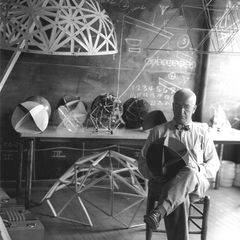
Buckminster Fuller BOOK 1981
Buckminster Fuller's synthesis of design science, resources, and the trajectory of humanity.
FORM
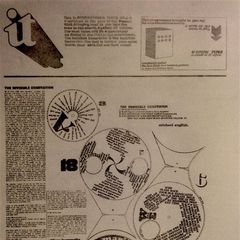
Jasia Reichardt EVENT 1968
The 1968 ICA London exhibition that introduced cybernetic, computer, and electronic art to a mass audience.
CYBERNETICS COMPUTATION PERCEPTION
Stafford Beer BOOK 1959
Stafford Beer's 1959 book founding management cybernetics, the application of cybernetic principles to organizations.
CYBERNETICS
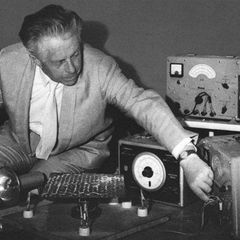
Hans Jenny FILM 1967
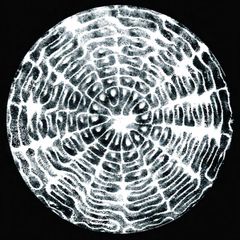
Hans Jenny's films making sound visible as form in vibrating matter.
TIME FORM MORPHOGENESIS SOUND
Hans Jenny BOOK 2001
Cymatics: A Study of Wave Phenomena and Vibration
Hans Jenny's study of periodic vibrational phenomena, illustrated with his own experiments in visible sound.
TIME FORM MORPHOGENESIS SOUND
Scottish biologist and mathematician; On Growth and Form pioneered the mathematical study of biological pattern.
MORPHOGENESIS FORM NUMBER
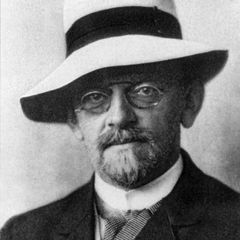
German mathematician who defended and axiomatized Cantorian set theory and posed the Entscheidungsproblem.
NUMBER FORM COMPUTATION
Digital Equipment Corporation HARDWARE
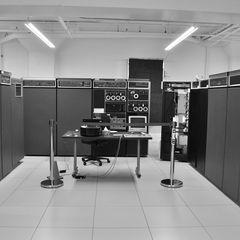
Digital Equipment Corporation mainframe used across early computer music research, including at Stanford's CCRMA.
COMPUTATION
W. Ross Ashby BOOK 1952
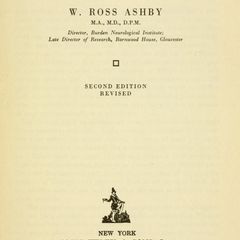
Ashby's book-length treatment of adaptive behavior as a self-stabilizing dynamical system, building on his homeostat.
CYBERNETICS FEEDBACK DYNAMICS
Stafford Beer LECTURE 1974
Beer's CBC Massey Lectures analyze why institutions fail through the lens of cybernetics — and how the science of effective organization could be used to redesign them.
FORM DYNAMICS CYBERNETICS
Gilles Deleuze BOOK 1968
Gilles Deleuze's 1968 thesis proposing difference as prior to identity, and repetition as productive rather than reproductive.
DYNAMICS FORM
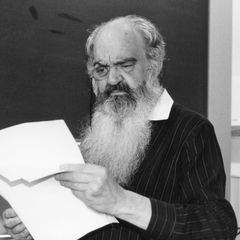
American cognitive scientist; author of Gödel, Escher, Bach.
NUMBER FORM COMPUTATION
J. Allan Hobson, Theodore Spagna, Paul Earls INSTALLATION 1977
J. Allan Hobson's traveling multimedia exhibit translating a sleeping subject's brain signals into live light and synthesized sound.
TIME PERCEPTION SOUND
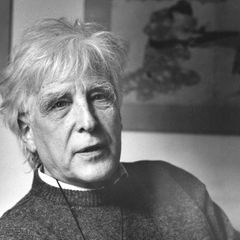
American statistician and political scientist; self-published The Visual Display of Quantitative Information after publishers declined it.
FORM PERCEPTION NUMBER
Ludwig Boltzmann, Claude Shannon CONCEPT
A measure of disorder or uncertainty — Boltzmann's statistical-mechanical quantity, and Shannon's 1948 measure of information.
NUMBER DYNAMICS
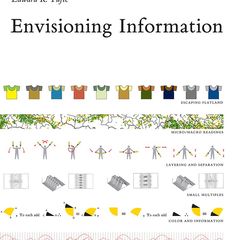
Edward Tufte BOOK 1990
Tufte's 1990 study of dense two-dimensional information design — maps, diagrams, timetables, and scientific illustration.
FORM PERCEPTION
EVENT 1970
The 1970 World Exposition in Osaka, Japan, host to the experimental Pepsi Pavilion.
Norbert Wiener CONCEPT
A system's output routed back as its own input, forming a causal loop — the organizing mechanism of self-regulation in cybernetics.
DYNAMICS CYBERNETICS FEEDBACK
1930
French psychoanalyst and philosopher; with Gilles Deleuze, developed schizoanalysis and the concept of the rhizome.
DYNAMICS FORM
Chilean biologist and philosopher; co-originator, with Humberto Maturana, of the concept of autopoiesis.
MORPHOGENESIS CYBERNETICS PERCEPTION
German mathematician who founded set theory and the study of transfinite numbers and the infinite.
NUMBER FORM
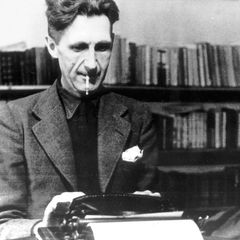
English writer; Nineteen Eighty-Four's Newspeak made language control and the rewriting of memory a working political mechanism.
LANGUAGE MEMORY
French philosopher and librarian; general economy, excess, and expenditure as the necessary discharge of a system's surplus.
DYNAMICS
Douglas Hofstadter BOOK 1979
Gödel, Escher, Bach: An Eternal Golden Braid
Hofstadter on self-reference, formal systems, and strange loops across logic, art, and music.
NUMBER FORM COMPUTATION
British cybernetician known for conversation theory and adaptive, interactive machines.
CYBERNETICS PERCEPTION FEEDBACK LANGUAGE
CONCEPT
A device that automatically regulates a machine's speed by feeding its output back as a correction to its input — the historical root of the word cybernetics.
DYNAMICS CYBERNETICS FEEDBACK
Jacob Klein BOOK 1968
Greek Mathematical Thought and the Origin of Algebra
Jacob Klein on the conceptual origins of algebra in and after Greek mathematics.
NUMBER FORM
Swiss physician and researcher who coined cymatics, the study of visible sound and vibration.
SOUND FORM MORPHOGENESIS
Austrian-American physicist and cybernetician; founder of second-order cybernetics and the Biological Computer Laboratory.
CYBERNETICS COMPUTATION PERCEPTION
Chilean biologist; co-originator, with Francisco Varela, of the concept of autopoiesis.
MORPHOGENESIS CYBERNETICS PERCEPTION
ORGANIZATION
Institut National de l'Audiovisuel (INA)
French national audiovisual archive institute; administrative home of the GRM since 1975.
SOUND MEMORY
ORGANIZATION
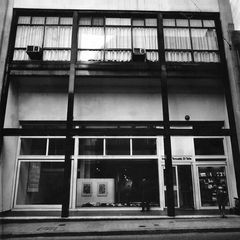
Buenos Aires cultural institute founded 1958, host to CLAEM and the most significant Argentine arts institution of the 1960s.
SOUND
American psychiatrist and sleep researcher who developed the activation-synthesis model of dreaming.
TIME PERCEPTION
Russian-American philosopher; phenomenology, the history of mathematics, and the concept-formation behind Greek and modern algebra.
NUMBER FORM
British mathematician; inventor of the Game of Life and the surreal numbers.
NUMBER FORM MORPHOGENESIS COMPUTATION
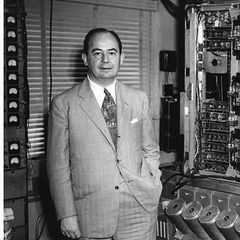
Mathematician; foundational to computing, game theory, and self-reproducing automata.
NUMBER MORPHOGENESIS CYBERNETICS COMPUTATION
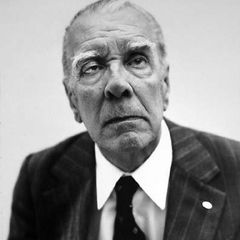
Argentine writer of labyrinthine short fictions on infinity, time, memory, and language.
LANGUAGE TIME MEMORY
American psychologist; argued consciousness is a recent, language-built construction, not an ancient human universal.
LANGUAGE PERCEPTION MEMORY
American botanist at Cornell; plant biomechanics, allometry, and the evolution of morphology.
MORPHOGENESIS FORM
ORGANIZATION
German professional audio manufacturer, founded shortly after WWII, later absorbed into Sennheiser/Neumann.
SOUND INSTRUMENTS
ORGANIZATION
American manufacturer of test and measurement instruments, including precision filters, amplifiers, and distortion analyzers.
INSTRUMENTS
Henri Poincaré CONCEPT
An isolated closed trajectory in a dynamical system's phase space that nearby states spiral toward, or away from — the mathematical signature of a stable, self-sustaining oscillation.
TIME FORM DYNAMICS
LANGUAGE
Family of programming languages built around symbolic expressions, dating to 1958.
COMPUTATION LANGUAGE
CONCEPT
A space that locally resembles ordinary flat (Euclidean) space, even where its overall shape is curved or otherwise complex.
NUMBER FORM SPACE
CONCEPT
A system's capacity to retain past states and let them shape future behavior — a basic requirement for learning, control, and computation alike.
TIME CYBERNETICS COMPUTATION MEMORY
Stanisław Lem STORY 1971
Lem's fictional account of 'personoids' — conscious beings created inside a computer, who reason their way to theology.
COMPUTATION PERCEPTION LANGUAGE
American mathematician who founded cybernetics, the study of control and communication in animal and machine.
CYBERNETICS FEEDBACK
Alan Turing PAPER 1936
On Computable Numbers, with an Application to the Entscheidungsproblem
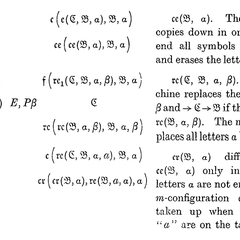
Turing's 1936 paper defining the Turing machine and the limits of mechanical computation.
COMPUTATION NUMBER
D'Arcy Wentworth Thompson BOOK 1917
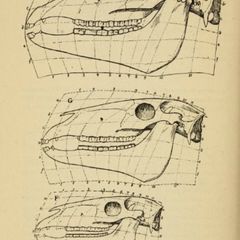
D'Arcy Thompson's classic on the mathematics and physics of biological form.
MORPHOGENESIS FORM NUMBER
American video artist and cybernetician; a founder of the Raindance media collective and author of Cybernetics of the Sacred.
CYBERNETICS PERCEPTION LANGUAGE
CONCEPT
The position of a periodic waveform within its cycle, and the basis for describing how two periodic signals align or diverge over time.
TIME NUMBER COMPUTATION
Nicolas Minorsky CONCEPT
A control algorithm that corrects a system's error using three combined terms — proportional, integral, and derivative — the standard formal method behind most feedback control.
DYNAMICS CYBERNETICS COMPUTATION FEEDBACK
Stafford Beer, Gordon Pask SYSTEM 1971
Stafford Beer's real-time cybernetic system for managing the Chilean economy, built for Salvador Allende's government, 1971–73.
TIME CYBERNETICS COMPUTATION FEEDBACK
CONCEPT
Two periodic signals offset by exactly a quarter cycle (90°) — the relationship behind quadrature oscillators, phase detection, and stereo/spatial encoding.
TIME NUMBER COMPUTATION
Franklin R. Collbohm ORGANIZATION 1948
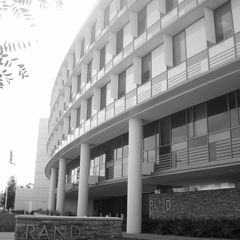
American nonprofit research institution, founded 1948, that formalized systems analysis and incubated early computing, game theory, and packet-switching research.
CYBERNETICS COMPUTATION
LANGUAGE
Stanford Artificial Intelligence Language, used at CCRMA for computer music programming including Chowning's Stria.
COMPUTATION LANGUAGE
CONCEPT
A feedback control system that continuously compares a mechanism's actual position or speed against a target and corrects the error.
DYNAMICS CYBERNETICS FEEDBACK
British theorist who founded management cybernetics and designed Chile's Project Cybersyn.
FORM CYBERNETICS FEEDBACK
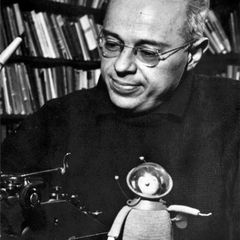
Polish writer and philosopher of technology; science fiction as a vehicle for cybernetic and epistemological speculation.
CYBERNETICS COMPUTATION LANGUAGE
CONCEPT
An abstract model of computation consisting of a finite set of states and the rules that transition between them in response to input.
TIME COMPUTATION MEMORY
British-American scientist known for cellular automata and a computational view of nature.
FORM MORPHOGENESIS DYNAMICS COMPUTATION
Shinya Tsukamoto, Chu Ishikawa FILM 1989
Shinya Tsukamoto's 1989 cyberpunk body-horror of flesh fusing violently with metal.
FORM
Georges Bataille BOOK 1949
Georges Bataille's theory of general economy — expenditure, excess, and the necessary loss of surplus energy.
DYNAMICS
Gordon Pask ESSAY 1969
The Architectural Relevance of Cybernetics
Pask's argument for cybernetics as a theory of architecture and interaction.
FORM CYBERNETICS PERCEPTION SPACE
Alan Turing PAPER 1952
The Chemical Basis of Morphogenesis
Turing's 1952 paper proposing reaction–diffusion systems as the origin of biological pattern.
MORPHOGENESIS FORM DYNAMICS
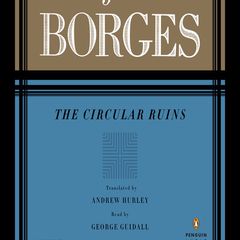
Jorge Luis Borges STORY 1940
A magician sets out to dream a man into being, then discovers that he too is another's dream.
FORM MORPHOGENESIS
William S. Burroughs ESSAY 1970
Burroughs's pamphlet on language as a virus and tape/electronic techniques of control and resistance.
LANGUAGE SOUND
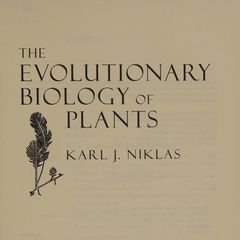
Karl J. Niklas BOOK 1997
The Evolutionary Biology of Plants
Karl Niklas on plant form, biomechanics, and the evolution of morphology.
NUMBER FORM MORPHOGENESIS
Tony Conrad FILM 1966
Tony Conrad's 1966 landmark of structural film, built entirely from alternating black and white frames.
TIME PERCEPTION FORM
William S. Burroughs ESSAY 1966
Burroughs on tape recorders, cut-ups, and jamming the reality studio of mass media.
LANGUAGE SOUND PERCEPTION
Jorge Luis Borges STORY 1941
The universe imagined as a total library containing every possible book of a fixed length.
NUMBER LANGUAGE SPACE
Jorge Luis Borges STORY 1941
A society governed ever more totally by an infinite lottery, until chance administers every event.
NUMBER FORM
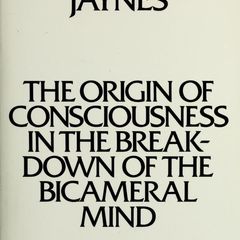
Julian Jaynes BOOK 1976
The Origin of Consciousness in the Breakdown of the Bicameral Mind
Julian Jaynes's theory that consciousness is a learned, language-based construction of recent historical origin.
LANGUAGE PERCEPTION MEMORY
Humberto Maturana, Francisco Varela BOOK 1987
The Tree of Knowledge: The Biological Roots of Human Understanding
Maturana and Varela on autopoiesis, cognition, and the biology of understanding.
MORPHOGENESIS CYBERNETICS PERCEPTION
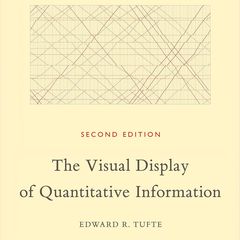
Edward Tufte BOOK 1983
The Visual Display of Quantitative Information
Tufte on the principled graphical display of data.
FORM NUMBER PERCEPTION
Jorge Luis Borges STORY 1940
The encyclopedia of an invented world slowly begins to overwrite reality itself.
LANGUAGE FORM MEMORY
CONCEPT
A finite, ordered sequence of elements — the general form behind coordinates, database records, and structured data of every kind.
NUMBER FORM COMPUTATION
Alan Turing CONCEPT
An abstract model of computation — an infinite tape, a read/write head, and a finite table of rules — that defines what it means for a function to be computable at all.
COMPUTATION MEMORY
Italian neuroscientist and cyberneticist; founding director at the Max Planck Institute for Biological Cybernetics.
CYBERNETICS PERCEPTION COMPUTATION
W. Ross Ashby CONCEPT
In cybernetics, the number of distinguishable states a system can take on — and, per Ashby's Law of Requisite Variety, the true measure of a regulator's power to control.
NUMBER CYBERNETICS
CONCEPT
A quantity with both magnitude and direction, represented as an ordered set of components — one of the basic building blocks of geometry, physics, and computation.
NUMBER FORM COMPUTATION SPACE
Valentino Braitenberg BOOK 1984
Vehicles: Experiments in Synthetic Psychology
Braitenberg's thought experiments in which simple sensorimotor machines produce lifelike behavior — a foundational text on emergence from minimal parts.
MORPHOGENESIS DYNAMICS CYBERNETICS PERCEPTION
Stafford Beer CONCEPT
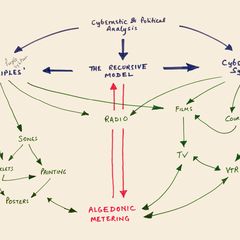
Stafford Beer's model of organizational structure, mapped by analogy to the nervous system, recursively nesting five subsystems.
FORM CYBERNETICS FEEDBACK
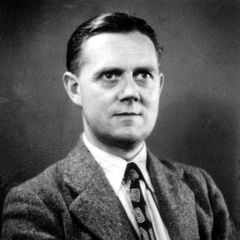
English psychiatrist and cyberneticist; formulated the Law of Requisite Variety.
NUMBER DYNAMICS CYBERNETICS FEEDBACK
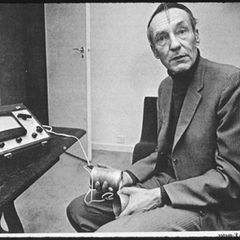
American writer; the cut-up method, tape-recorder experiments, and language as a control system.
LANGUAGE SOUND







Drag to pan, scroll to zoom, hover or click a point to focus it, click its card to open it.
No relationships among the matching entries.