Library SARC Research Person
Stephen Wolfram
British-American scientist known for cellular automata and a computational view of nature.
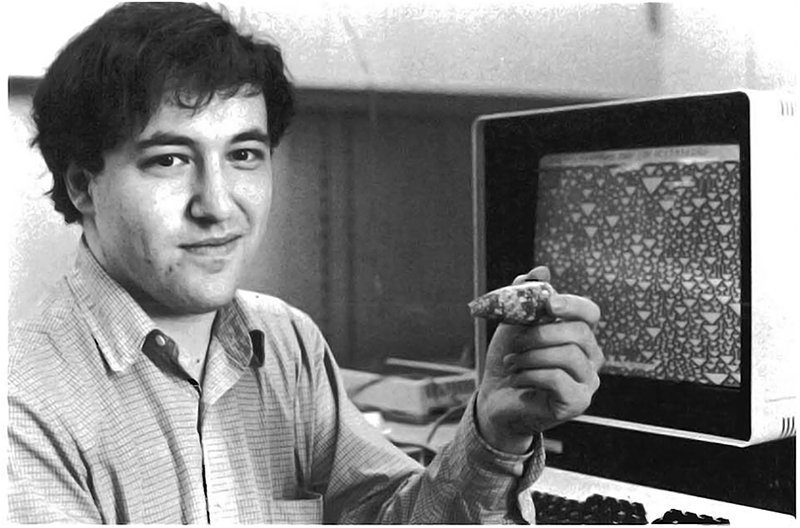
Stephen Wolfram (b. 1959, London) published his first physics papers at fifteen, left Eton in 1976, and entered St John’s College, Oxford, at seventeen before departing in 1978 without a degree; he completed a PhD in particle physics at Caltech in 1980, at age 20, and became the youngest-ever MacArthur Fellow the following year. At Caltech he built the Symbolic Manipulation Program (1979–1981), the basis for the algebra system he later rebuilt from scratch as Mathematica, releasing it through his own company, Wolfram Research (founded 1987), on 23 June 1988. His extensive study of simple cellular-automaton rules — programs that generate intricate, sometimes irreducibly complex behavior from a handful of instructions — culminated in A New Kind of Science (2002), arguing that such computation, not traditional mathematical equations, is the right lens for much of nature. He went on to launch the answer engine Wolfram Alpha in 2009 and announce the Wolfram Physics Project in 2020.