Raymond Scott
American composer and inventor who built early machines for automatic music composition.
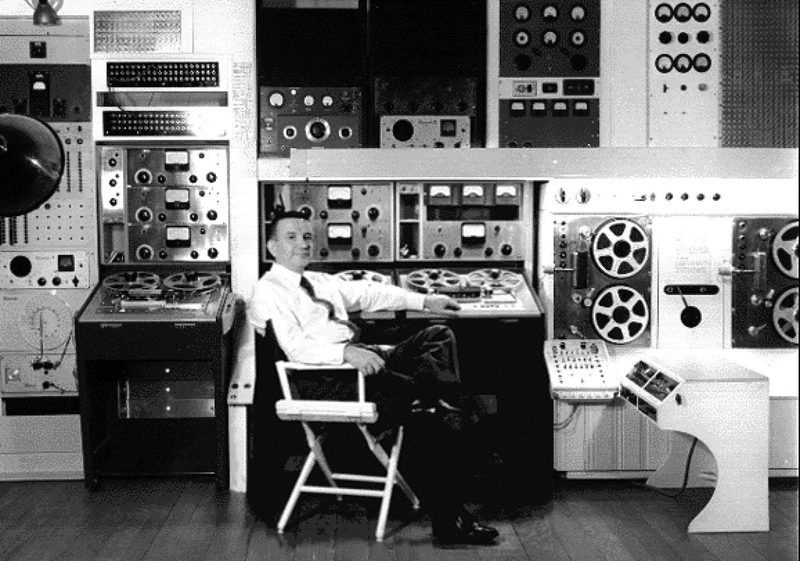
Born Harry Warnow in Brooklyn in 1908, Raymond Scott adopted a pseudonym to lead his own ensembles alongside his bandleader brother, forming the six-piece Raymond Scott Quintette in 1936 and scoring novelty-jazz hits like “Powerhouse” and “The Toy Trumpet” — pieces Carl Stalling later adapted into over 120 Warner Bros. Looney Tunes and Merrie Melodies scores after Scott sold his publishing rights to the studio in 1943. Scott turned to electronics full-time with Manhattan Research, Inc., founded in 1946, building ring modulators, envelope shapers, and sequencers pursuing a lifelong project of automatic composition; his most ambitious device, the Electronium — by his own account eleven years and nearly a million dollars in the making — was a self-composing tone-and-rhythm generator. For the Clavivox, a ribbon-controlled keyboard synthesizer, Scott brought in a young Robert Moog, who met him in the 1950s and designed circuits for him through the 1960s. In 1971 Berry Gordy hired Scott as director of Motown’s electronic music and research department, a post he held until 1977.
Works in the Library
Raymond Scott ALBUM 2000
Basta Audio Visuals' 2000 two-CD anthology of Raymond Scott's unreleased electronic recordings, 1953-1969.
INSTRUMENTS