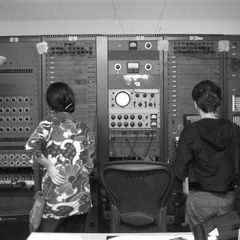
Milton Babbitt
American composer and theorist who extended twelve-tone method into total serialism and pioneered composition with the RCA Mark II.
Milton Babbitt (1916–2011) studied composition with Roger Sessions at Princeton University, where he joined the faculty in 1938 and taught for most of his career. During World War II he began extending Schoenberg’s twelve-tone method beyond pitch to duration, dynamics, timbre, and register, arriving independently at what became known as total serialism; his Three Compositions for Piano (1947) are among its earliest examples. In 1959 he co-founded the Columbia-Princeton Electronic Music Center with Otto Luening, Vladimir Ussachevsky, and Roger Sessions, drawn to the RCA Mark II Sound Synthesizer’s ability to realize precisely serialized rhythm beyond what live performers could execute. His electronic works composed there include Composition for Synthesizer (1961) and Ensembles for Synthesizer (1964), and Philomel (1964), for soprano with synthesized accompaniment and manipulated recorded voice. He received a Pulitzer Prize Special Citation in 1982 and a MacArthur Fellowship in 1986.
Works in the Library
Olivier Messiaen, Pierre Boulez, Karlheinz Stockhausen, Milton Babbitt CONCEPT
Extending serial ordering beyond pitch to duration, dynamics, and timbre, pioneered by Messiaen, Boulez, and Stockhausen.
TIME NUMBER FORM
Related Groups in the Library
Vladimir Ussachevsky, Otto Luening, Milton Babbitt, Roger Sessions, Vladimir Ussachevsky ORGANIZATION
Columbia-Princeton Electronic Music Center
Joint Columbia/Princeton studio founded 1958-59 around the RCA Mark II synthesizer, the oldest electroacoustic music center in the US.
INSTRUMENTS