Journal WORKLOG
Sonifying the Computation of Pi
A clocked computational process whose intermediate state becomes control voltage.
The question this worklog follows is narrow: what does it sound like when a machine computes π? Not the number read aloud, but the process — the intermediate state of an algorithm, tapped continuously and routed into the control-voltage domain of the SARC‑100.
The process as oscillator
A spigot algorithm produces the digits of π one at a time, but its internal registers move constantly between digit emissions. Those registers are the material. On each tick of a slow master clock the current register value is latched, scaled, and written to a DAC channel as a control voltage.
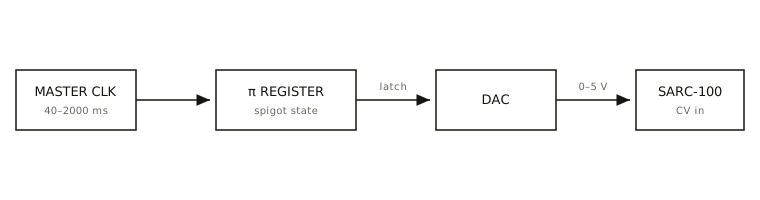
Because the register state is deterministic, the sequence is fixed — the same every run — but it is not periodic on any human timescale. It reads as structured and non-repeating at once, which is exactly the quality worth chasing.
Clocking and range
Two parameters do most of the work:
| Parameter | Range | Effect |
|---|---|---|
| Clock period | 40 – 2000 ms | Density of events; the “tempo” of compute |
| Register scaling | 0 – 5 V | Mapping of state onto pitch/timbre |
At long clock periods the computation becomes a slow melodic contour. Below roughly 60 ms per tick the same data crosses into the audio rate and the register sequence is heard directly as timbre rather than as a sequence of pitches.1
What the video shows
The recording below runs the process open-loop for four minutes: first at a slow clock, then accelerating until the register crosses into audio rate. No pitch quantisation — the raw scaled voltage drives the oscillator so the arithmetic stays audible.

Next
The register tap is currently single-channel. The next pass splits high and low words of the register onto two DAC channels so the same computation drives two coupled voices — the beginning of treating an algorithm as a small ensemble.
The 60 ms figure is approximate and depends on the register’s rate of change, which is not constant across the algorithm’s run. ↩︎